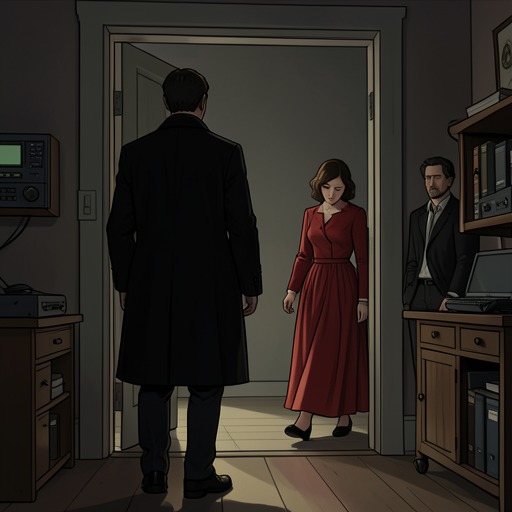
Konrad
Berlin AlexanderplatzKonrad is a young burglar whose release from Brandenburg penitentiary becomes the turning point in Reinhold’s prison life and, indirectly, in Reinhold’s capture. A close friendship grows between the two men in prison, but once Konrad is free, a confidence he shares with an old acquaintance reaches the police. The resulting betrayal is not a direct denunciation by Konrad; it is the consequence of what he tells, and to whom.
Identity and Background
Konrad is from Mecklenburg and is serving his first term in Brandenburg penitentiary. He is due to be released in March. The narrative describes him as a young burglar with the potential to become a hardened criminal; he has already committed burglaries in Pomerania with two other men, one of whom is serving a ten-year sentence. The account gives little of his life beyond prison and crime, but establishes that he is entering the outside world with criminal experience and limited prospects.
His name is itself presented as uncertain: the narrator says that Konrad is the name he goes by. That qualification places him among people whose identities are provisional and whose lives are shaped by aliases, prison records, and police searches. Later, Reinhold gives Konrad information about himself under the name Moroskiewicz, making the distinction between a man and the name under which he is known especially consequential.
Friendship with Reinhold in Prison
Konrad and Reinhold first draw close through their shared resentment of Dluga. Their contact begins in the prison tobacco shop, where they curse him together, and develops into an unusually strong friendship for Reinhold. Konrad is not a romantic partner, but the narrative presents this companionship as a rare source of comfort for Reinhold, whose recurring attachments to women have otherwise brought him both hope and trouble.
The approaching release unsettles Reinhold. On the evening before Konrad is to leave, Reinhold fears being alone again and begs Konrad to take him along. Konrad offers comfort but does not encourage an escape. Recent escape attempts have ended badly or failed, and he tells Reinhold that there is no point in trying. His response is practical: he recognizes the danger and does not promise a way out of a situation he cannot change.
The two drink methylated spirits obtained from the carpentry workshop. Reinhold becomes more distressed, and Konrad helps him into bed. In this state, Reinhold confides in him: he gives Konrad the address of a woman he calls his girl, asks him to visit her, and requests news about his own affairs, including what Dluga may have discovered. He also begins to explain his history with Franz Biberkopf. Konrad listens and learns the information Reinhold has withheld from most people around him. The disclosure turns their friendship into a channel through which Reinhold’s hidden identity can travel beyond the prison walls.
Release and the Information Reaches Berlin
On Friday, Konrad goes to Reinhold’s girl in Berlin. She receives him warmly, and he spends days telling her about Reinhold; she gives him money as well. The narrative shows Konrad carrying out the visit Reinhold requested, but it does not say that he reports Reinhold to the police or intends to expose him.
By Monday, Konrad’s account has begun to spread through another relationship. He meets an unemployed friend from reform school in Seestrasse, boasts about his improved circumstances, pays for him at a pub, and later spends the evening with him. During their subsequent conversation, Konrad identifies Reinhold by the name Moroskiewicz and says that he is wanted in connection with something serious. He also reveals that a substantial reward may be offered. Once Konrad has said too much, he recognizes his mistake, but his friend promises to keep quiet and takes money from him.
The confidence does not remain secret. On Tuesday, the friend sees the police posters at Berlin Police Headquarters and finds confirmation that Reinhold is wanted in the murder case involving Emilie Parsunke in Freienwalde. The poster gives a reward of 1,000 marks. Pressed by his girlfriend and tempted by the money, the friend and the girlfriend go to the police. The friend supplies what he knows about Reinhold’s identity and whereabouts but conceals how he learned it. Thus Konrad’s disclosure enables the report, while the decision to inform belongs to the friend and his girlfriend.
Capture and Narrative Role
On the following Saturday, Konrad travels to Brandenburg penitentiary to visit Reinhold, bringing items from Reinhold’s girl and from Pums. In the train compartment he sees a Thursday-evening newspaper reporting that the Freienwalde murderer has been caught under a false name. The news makes the consequences of the information chain plain to him. The narrative gives Konrad the recognition that his words helped bring about the capture, though the police report itself was made by someone else.
Konrad’s role is therefore defined by an unintended breach of trust rather than by a deliberate police informant’s plan. He is loyal enough to make the prison visit Reinhold asked of him, yet careless enough to boast and disclose what he has learned to a man he believes will stay silent. His story also completes Reinhold’s prison friendship in an ironic way: Konrad’s release gives Reinhold a companion to cling to, then carries Reinhold’s name into the outside world where it can be matched to the wanted notices. After his arrest, Reinhold is returned to Berlin and held in Moabit penitentiary while awaiting trial. Konrad is not shown taking part in the arrest; his significance lies in the confidence that set its immediate chain of events in motion.